We now have a clearer picture of what Extended Producer Responsibility (EPR) packaging programs may cost in 2027.
Circular Action Alliance (CAA) has published 2027 producer fee schedules for California, Colorado, and Oregon, along with early fees for Washington.
During an October 21 webinar, CAA also outlined how those fees are calculated, why they differ by state, and what producers can expect as implementation continues.
For fresh produce companies, these published schedules provide an opportunity to move from planning to budgeting. Companies can begin estimating their costs using packaging data they have already reported, but they also need to prepare for upcoming invoices, another year of reporting and requirements that will continue to evolve.
Here's what fresh produce companies should know and what they can do now.
Key Dates and Deadlines
Several important EPR deadlines are approaching.
November 15, 2026 - Validation responses due: Companies that received validation notices from CAA have been asked to respond by November 15. Responding helps ensure January invoices reflect accurate packaging data.
January 2027 - Producer invoices arrive: CAA will issue invoices for California, Colorado, Oregon, and Washington based on the 2025 supply data producers reported in 2026.
May 31, 2027 - Next annual reporting deadline expected: Reports on 2026 packaging data are expected to be due May 31, 2027, and will be used to set 2028 fees. States with expected 2027 reporting include California, Colorado, Maryland, Minnesota, Oregon, and Washington.
These deadlines reinforce that EPR reporting is not a one-time requirement. Companies need to prepare for an ongoing cycle of collecting data, reporting, and paying fees.
How Are the EPR Fees Calculated?
CAA uses one national methodology that is applied to each state's EPR program. While the overall approach is consistent, fees differ because each state has its own regulatory requirements, program costs, and mix of packaging materials.
CAA's methodology considers three main components:
Total Program Costs: The cost of operating each state's EPR program. Costs vary by state, depending on existing recycling systems and state law.
Relative Material Costs: The cost of collecting, sorting, and recycling different packaging materials. Some materials are more expensive to manage than others.
Producer-Reported Supply: The amount and type of packaging materials each producer sells into a state, based on the data reported to CAA.
Using these inputs, CAA establishes a fee rate for each material category, generally expressed in cents per pound.
A producer's fee is then calculated by multiplying the amount of packaging reported in each category by the applicable rate, with adjustments for state-specific incentives or penalties, also known as eco-modulation.
What Does This Mean for Fresh Produce Packaging?
The amount of packaging a company uses matters, but so does the type of material.
Clamshells, plastic film, cartons and other packaging materials can carry different rates depending on the state and material category.
For produce companies, this means that understanding packaging weights and material types is increasingly important, not just for reporting, but also for understanding costs and evaluating future packaging decisions.
Accurate data is essential. Without it, companies may struggle to estimate their fees, identify their largest cost drivers or make informed decisions about their packaging.
Where Does the Money Collected from EPR Fees Go?
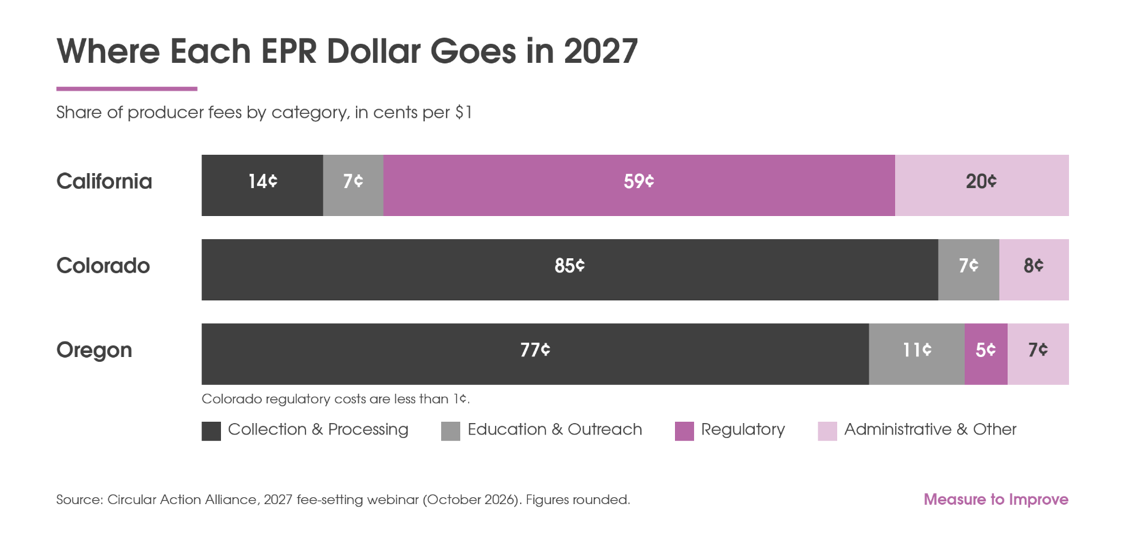
The 2027 schedules also provide a clearer picture of how EPR fees will be used. While the programs share similar goals, the allocation of funding varies by state.
California: Approximately 29 cents of every dollar funds core program activities, while 59 cents covers regulatory costs, including CalRecycle, closure funds, and the state's Plastics Pollution Mitigation Fund, which alone accounts for 49 cents of every dollar.
Colorado: Approximately 92 cents of every dollar goes directly toward collection, processing, education and outreach.
Oregon: Approximately 88 cents of every dollar supports collection, processing, education and outreach activities.
Washington: Unlike the other three states, Washington's published early fees support program development, startup and regulatory costs required under its Recycling Reform Act.
Published Fees Are Not Necessarily Final
While the published schedules provide an important planning tool, companies should keep several things in mind.
California's fees remain preliminary: The state's 2027 fee rates are subject to regulatory approval of CAA's program plan. CAA submitted its revised plan to CalRecycle on October 13, 2026. CalRecycle has 75 calendar days after receiving it to approve, disapprove or conditionally approve the plan.
Oregon's lower 2027 rates are temporary: CAA is returning excess reserves from the program's initial years, reducing rates for 2027. CAA expects those rates to increase in future years.
Washington's fees support program development: These are early fees intended to fund startup activities. Full program fees will follow as Washington's EPR program develops.
Fee rates will change over time: CAA develops state program budgets annually, meaning rates can change as program costs, reported supply, and regulatory requirements evolve. Companies can use the published rates and their reported packaging data to estimate costs, but CAA invoices will determine the official amounts owed. Those amounts may differ from initial estimates because of data corrections, incentives or other adjustments.
What Companies Should Be Doing Now?
Whether your company is preparing for its first EPR reporting requirements or already participating in multiple state programs, there are practical steps to take now.
If You're Just Getting Started
Registration, reporting, and initial payment deadlines have already passed in several states. For companies that have not yet begun preparing, the priority should be understanding their obligations and establishing a process that works year after year.
Confirm your status first: Work with your legal counsel to determine whether your company is a producer in each state. Every other step depends on this determination.
Name owners for each piece: EPR reporting requires information from different parts of the business. Accounting handles invoices and budgeting, packaging or procurement manages specifications and weights, and sales tracks volumes by state. Identify who is responsible for each component and who will coordinate the overall process.
As Corinne Carney, Director of Sustainable Solutions at Measure to Improve, explains:
"A big surprise for most teams is how much packaging data lives outside the sustainability team. Procurement, sales and finance each hold a piece, so naming an owner for each one makes a real difference."
Gather data for past and upcoming reports: Reports due in 2027 will generally use calendar year 2026 data, but companies just getting started may also need information from earlier years to address previous reporting requirements. In California, for example, the baseline report uses 2023 data, while reports submitted in 2026 used 2025 data.
Document as you go: Keep a record of data sources, assumptions and calculation methods. This makes it easier to respond to questions from CAA and helps streamline future reporting.
If You're Already Reporting
For companies that have already submitted reports, the published fee schedules provide an opportunity to better understand costs and prepare for the next reporting cycle.
Start by estimating your 2027 fees: Use the packaging amounts reported in 2026 and the published rates for each applicable state. For California, account for additional plastic-related fees and remember that rates remain preliminary.
Prepare for January invoices: Respond to any outstanding validation requests and confirm that billing contacts are current in the CAA Producer Portal.
Identify your biggest fee drivers: Rather than looking only at packaging weight, review which materials and packaging items account for the largest estimated fees. Understanding your top three to five cost drivers can help inform future packaging decisions.
Begin organizing 2026 data: The next annual reporting cycle will generally rely on 2026 packaging information. Use what you learned from previous reports to address data gaps, improve documentation, and prepare for upcoming requirements.
The goal is to make each reporting cycle more manageable rather than rebuilding the process every year.
How MTI Can Help
At Measure to Improve, our EPR Readiness Solution is designed to help fresh produce companies understand requirements, organize packaging information, and build the internal processes needed to support ongoing compliance.
Your team brings the knowledge of your products, packaging and operations. MTI brings EPR expertise and guidance to help you navigate the requirements and prepare.
We work alongside your team to identify reporting requirements, understand available guidance and calculation methodologies, organize data, and clarify internal responsibilities. We also provide resources and key questions to support your legal team's determination of producer obligations.
The goal is not simply to prepare for the next invoice or reporting deadline. It is to establish a practical, repeatable process that helps your company manage EPR requirements as they continue to evolve.
With 2027 fees now published, fresh produce companies have more information to understand their potential costs and make informed decisions – but you still need a plan.
Learn more about Measure to Improve’s EPR Readiness Solution and how we can support your team.